

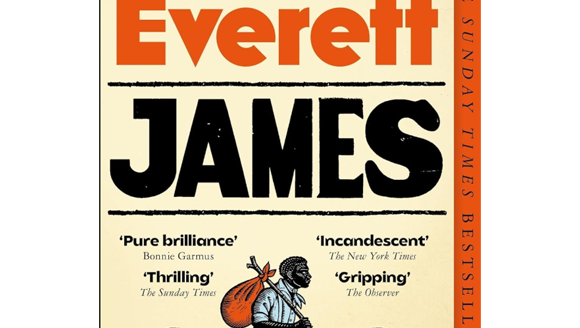
‘James’ by Percival Everett
PULITZER PRIZE WINNER • #1 NEW YORK TIMES BESTSELLER • NATIONAL BOOK AWARD WINNER • A brilliant, action-packed reimagining of Adventures of Huckleberry Finn, both harrowing and darkly humorous, told from the enslaved Jim's point of view • In development as a feature film to be produced by Steven Spielberg
Storytelling:
What is not to like about a story describing a famous character Huckleberry Finn, living in Missouri in the 1830’s, created by Mark Twain. However, Huck is not our protagonist. The story is written from the point of view of an older slave named Jim who weaves a journey along the river Mississippi taking with him Huck as a sidekick. I think why it brings a personal fondness is that I saw the Huckleberry Finn film in the 1970’s and I loved the idea of a slightly wild upbringing in America, where families ate corn bread and fish which they caught from the river. However, there is a dark side to this story as the adventurers encounter flogging, rape, drowning and murder all set under a backdrop of slave trading and abuse. Some folk attempt to hide that it ever actually happened. No-one likes the ‘N’ word, but it’s used a lot in this. It’s a modern challenge to retell a story but that’s exactly what storytellers have been doing all along. Adding bits, embellishing the tale each time it is told, and perhaps by each fresh storyteller. So why is this different?
Ideas:
There is a theme of good over evil. Characters such as the slave overseer Tom Hopkins, who he witnesses raping a slave girl is a prime example. Hopkins gets his just desserts as Jim strangles him to death. However, when distributing retribution on other evil men, Jim turns the tables on Judge Thatcher, making him his slave for a few hours, but stops himself from outright killing the man.
Jim joins the Virginia Minstrels as a tenor singer. It’s more accurate to say he was sold into the troupe of Black and White minstrels, but he would earn money from each show and eventually earn enough to pay his way out of the act. The irony is that the other, all white-skinned minstrels, used to ‘black up’ for their stage show with boot polish for example. However, for Jim, they ‘whited him up’ first then ‘blacked him up’ to keep the illusion alive that he was in fact white-skinned.
I loved the common objects used throughout the book: of a stolen pencil and a notebook which signify knowledge, creativity, power, strength and overall intelligence.
Outlining:
It is a snapshot of the time, a time of war and revolution of slavery. This novel revives historic songs from the era, frequently with repetitive lyrics echoing the repetitive work of slaves and written down as they were spoken.
Jim gives an illusion to his overseers and owners that he is stupid and not able to speak, yet in fact he is very articulate, well read and a teacher to others.
He meets some interesting sub characters, a pair of conmen known as The Duke of Bridgewater and a Dauphin. Jim adopts some of their cons, including the use of selling slaves to their mark, and the slave running away and repeating this activity with another mark.
There is a great plot twist as towards the end Huck finds out he is born of mixed race, as James is in fact Huck’s biological father.
Show vs tell:
There is a funny show scene, describing the tradition of ‘Dogging for catfish.’ In other words, fishing by using your own hand as bait, being supported by another fellow holding your legs to keep you from drowning. When the fish bites, drag it to the shore, shake it off your hand and club it.
Style and pacing
The short scenes ensure quite a fast pace. Also, there is extensive dialogue, often short sentences, giving the characters real life.
Star Review:
4/5